Augusta Road Greenville Home Prices: What the Median Misses
August 27, 2026
August 27, 2026
Pull up the last three months of sales data on Augusta Road and the headline number looks like a warning sign. The median sale price is down 20.2 percent year over year, landing at $917,131 for the period ending June 2026. If you're comparing neighborhoods and you see that kind of drop on what's supposed to be Greenville's most durable address, the instinct is to ask what went wrong.
Nothing went wrong. More homes sold. That's the whole story, and it's a more useful story than "prices fell" because it tells you something the median can't.
Over that same three-month window, the number of homes that closed on Augusta Road rose 41.3 percent. That's not a market cooling off. That's a market where a lot more transactions happened, and the mix of what changed hands shifted underneath the median while price per square foot moved only modestly.
Here's the tell: price per square foot on Augusta Road fell only 3.5 percent over the same period. If the street were genuinely losing 20 percent of its value, price per square foot would have moved with it. It didn't come close. A median can crater while the actual cost of a square foot of Augusta Road real estate barely budges, and that gap is the entire thesis of this post. The median isn't measuring the street. It's measuring which houses happened to sell.
Compare that to North Main, which sits at an almost identical median right now, around $915,000. North Main got there by rising 10.5 percent year over year, with price per square foot up 27.3 percent. Two neighborhoods, nearly the same number, opposite direction of travel. One repriced up. The other saw only a small drop in price per square foot as a different batch of houses sold. If you only read the median, Augusta Road and North Main look like the same market. They are not.
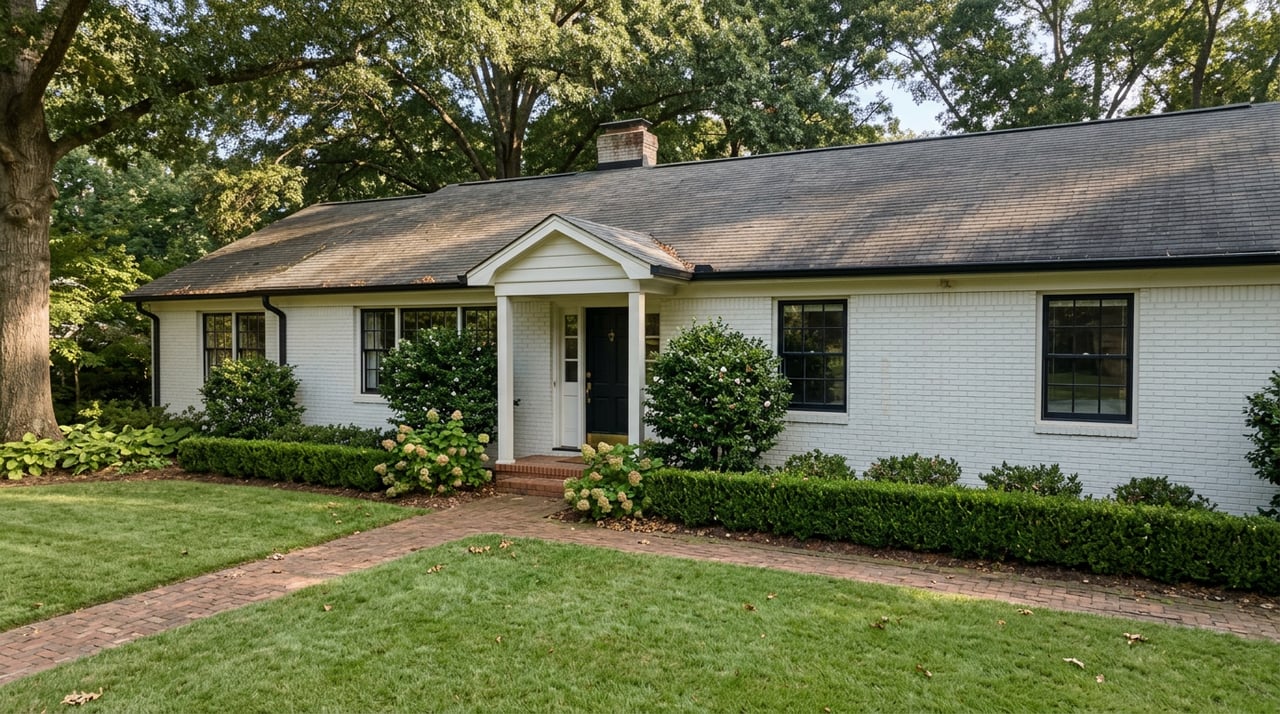
Augusta Road's housing stock is old by Greenville standards, much of it built well before 1970, on narrow lots under a mature tree canopy. A Greenville-area custom builder that works across Augusta Road, North Main, and Overbrook describes the pattern plainly: a tear-down-and-rebuild market dominates these corridors, driven by narrow, constrained lots, old clay-and-rock subgrade, and zoning and tree ordinances where setback and impervious-surface limits matter more than the buildable area on paper. In practice, that means a builder or a buyer with renovation intent isn't shopping the finished square footage of a 1,400-square-foot cottage. They're shopping the lot underneath it.
That's the mechanism behind the median. When more of these smaller, older, teardown-eligible homes sell in a given quarter, they pull the median price down even though nobody negotiated a discount on the land or the location. The house is almost incidental to the transaction. A buyer paying $500,000 for a cottage they intend to demolish is not getting a deal relative to a $1.2 million renovated estate two streets over. They're paying for dirt in one of Greenville's tightest infill markets, and the sale still counts as a data point that drags the median toward the middle.
This is also why homes are sitting slightly longer, a median of 52 days as of this reporting period, eight days more than a year earlier. That's consistent with more inventory turning over across a wider range of price points and conditions, not with buyers losing interest in the street.
If Augusta Road were actually softening, you wouldn't expect to see this kind of capital moving into the corridor at the same time. Augusta Gateway, a six-building, village-style retail development going into the former Terrace Shopping Center site at 3304-3350 Augusta Road, is delivering with a roughly 23,000-square-foot anchor space built out for a boutique grocery, hardware store, or entertainment tenant, according to reporting from Fox Carolina. The buildings are going up in warm-shell condition with a tenant improvement allowance, the kind of structure a developer uses when they expect to fill space with real, sustained retail demand rather than a speculative bet.
Greenville County has also been working on a strategic plan for the Augusta Road corridor that would convert the current five-lane road into a two-lane boulevard with sidewalks, a planted median, and bike lanes on both sides, as detailed in reporting from the Post and Courier. The plan also floats a Swamp Rabbit Trail spur along Brushy Creek, connecting Augusta Road to the existing trail network near Conestee Nature Preserve, using right-of-way already held by the state DOT or the local sewer authority rather than requiring the county to negotiate with dozens of private landowners. None of this is speculative marketing copy. It's public-sector planning aimed at a corridor the county already treats as underbuilt relative to demand, not one it's writing off.
You don't see this kind of infrastructure and retail investment pour into a neighborhood that's actually correcting 20 percent. You see it in a neighborhood absorbing a wave of teardown and infill activity that a backward-looking median statistic reads as a price decline.
If you're shopping Augusta Road right now, the practical takeaway is to stop anchoring on the median and start asking what a specific listing actually is. A smaller home on a large lot in areas like Alta Vista, zoned for Augusta Circle Elementary, or in Cherokee Park between Augusta Street and Grove Road, may be priced as a livable house when the real competition for it is a builder pricing the dirt. That changes your offer strategy, your inspection approach, and whether you should be comparing the listing to other finished homes or to recent teardown sales on comparable lot sizes.
If you're selling an updated, move-in-ready home here, the median working against you is a communication problem, not a pricing problem. Buyers and their agents who lean on a headline median without asking what's actually trading may undervalue a renovated property relative to what it would have commanded a year ago, when fewer teardown candidates were in the sales mix. Comps need to be built from homes in comparable condition, not from an average that's being pulled around by land sales dressed up as house sales.
Does a falling median mean Augusta Road is now a buyer's market? Not on its own. A falling median tells you what mix of homes sold, not what any individual home is worth. Price per square foot, which barely moved here, is the better gauge of whether the street itself is repricing.
How do I tell if a listing is priced as a teardown candidate rather than a livable home? Look at the lot size relative to the home's square footage, the age of the structure, and whether nearby recent sales on similar lots closed near land value rather than renovated-home value. A local agent who tracks Augusta Road's inventory closely can usually tell you within a few minutes which category a listing falls into.
Reading a median correctly on a street like this takes more than a Redfin snapshot. It takes knowing which pockets are trading as land and which are trading as finished homes, and that's the kind of detail that only comes from watching this specific corridor closely, deal by deal. If you're trying to figure out what a specific Augusta Road property is actually worth, or whether the timing makes sense for your sale, Amanda Holmes can walk through the comparables that actually apply to your situation. Schedule a consultation and get a read on the number that matters, not just the one making headlines.
This article is general information, not legal, tax or financial advice. Consult a qualified professional about your situation.
Stay up to date on the latest real estate trends.

Amanda takes pleasure in building relationships with her clients and their families, delving into their needs, and assisting them in discovering the ideal home that suits their distinctive lifestyles.